
The words "sprain" and "strain" are often used interchangeably — but they refer to injuries to completely different structures, with different mechanisms and slightly different rehabilitation approaches.
What Is a Sprain?
A sprain is an injury to a ligament — the fibrous connective tissue connecting bone to bone. Sprains occur when a joint is forced beyond its normal range of motion, overstretching or tearing the ligament. The most common example: rolling your ankle inward tears the lateral ankle ligaments. Other common sprains include wrist sprains, knee MCL sprains and finger sprains.
What Is a Strain?
A strain is an injury to a muscle or tendon. Strains occur when a muscle is forcibly stretched or contracts eccentrically under excessive load. Common examples: hamstring strain (a sharp, sudden pain in the back of the thigh during sprinting), calf strain, and quadricep strain.
Grades of Severity (Same Scale for Both)
- Grade 1 (mild): Microscopic tearing of fibres. Localised tenderness, minimal swelling, no functional loss. Returns to sport in 1–3 weeks.
- Grade 2 (moderate): Partial tear — significant tenderness, swelling and bruising, some functional loss. Returns in 3–6 weeks.
- Grade 3 (severe): Complete rupture. Significant swelling, bruising and instability. May require surgical consideration. Timeline 6 weeks to 12+ months.
Key Difference in Rehabilitation
Ligament sprains (particularly Grade 2–3) require significant focus on proprioceptive retraining — ligaments contain mechanoreceptors contributing to joint position sense, and these are damaged in a sprain. Without proprioceptive rehabilitation, re-injury risk remains elevated even after pain has resolved. Muscle strains focus more on progressive loading through full range of motion and eccentric strengthening.
Need help with this? Our team at Elevate Health Clinic in Bella Vista and Earlwood can assess and treat this condition. Book online or call us today.
Initial Management — The First 48–72 Hours
The POLICE principle (Protection, Optimal Loading, Ice, Compression, Elevation) is the current best-practice framework for acute sprains and strains, replacing the older RICE model. The key evolution is the shift from "Rest" to "Optimal Loading" — recognising that early, controlled movement improves outcomes compared to immobilisation.
Protection means avoiding activities that risk further injury in the acute phase — not complete rest. Optimal loading means introducing gentle, pain-appropriate movement as early as tolerated. Ice reduces pain and provides analgesic benefit; 15–20 minutes every 2 hours in the first 48 hours is a standard protocol. Compression (an elasticated bandage applied with appropriate tension) reduces swelling. Elevation above the level of the heart reduces hydrostatic pressure and oedema formation.
Anti-inflammatory medications (NSAIDs) are commonly used in the first 48–72 hours for pain management — but there is growing evidence that excessive anti-inflammatory suppression in the very early phase may delay tissue healing, as the inflammatory response is a necessary precursor to repair. Brief, judicious use appears reasonable; prolonged NSAID use for sprains and strains is not supported by evidence.
Rehabilitation Beyond the Acute Phase
Once the acute inflammatory phase has settled (typically 3–5 days), the focus shifts to progressive rehabilitation: restoring range of motion, rebuilding strength through the injured tissue, and reintroducing functional movement patterns. This phase is where most patients either do too little (returning to activity before the tissue is ready) or too much (loading too aggressively and provoking a setback).
For ankle sprains — the most common ligament injury — proprioception and neuromuscular control training is particularly important. Recurrence rates for lateral ankle sprains are high precisely because the ligament heals structurally but the proprioceptive function of the mechanoreceptors within it is impaired. Balance training (single-leg standing, wobble board, perturbation training) addresses this gap and significantly reduces re-injury risk.
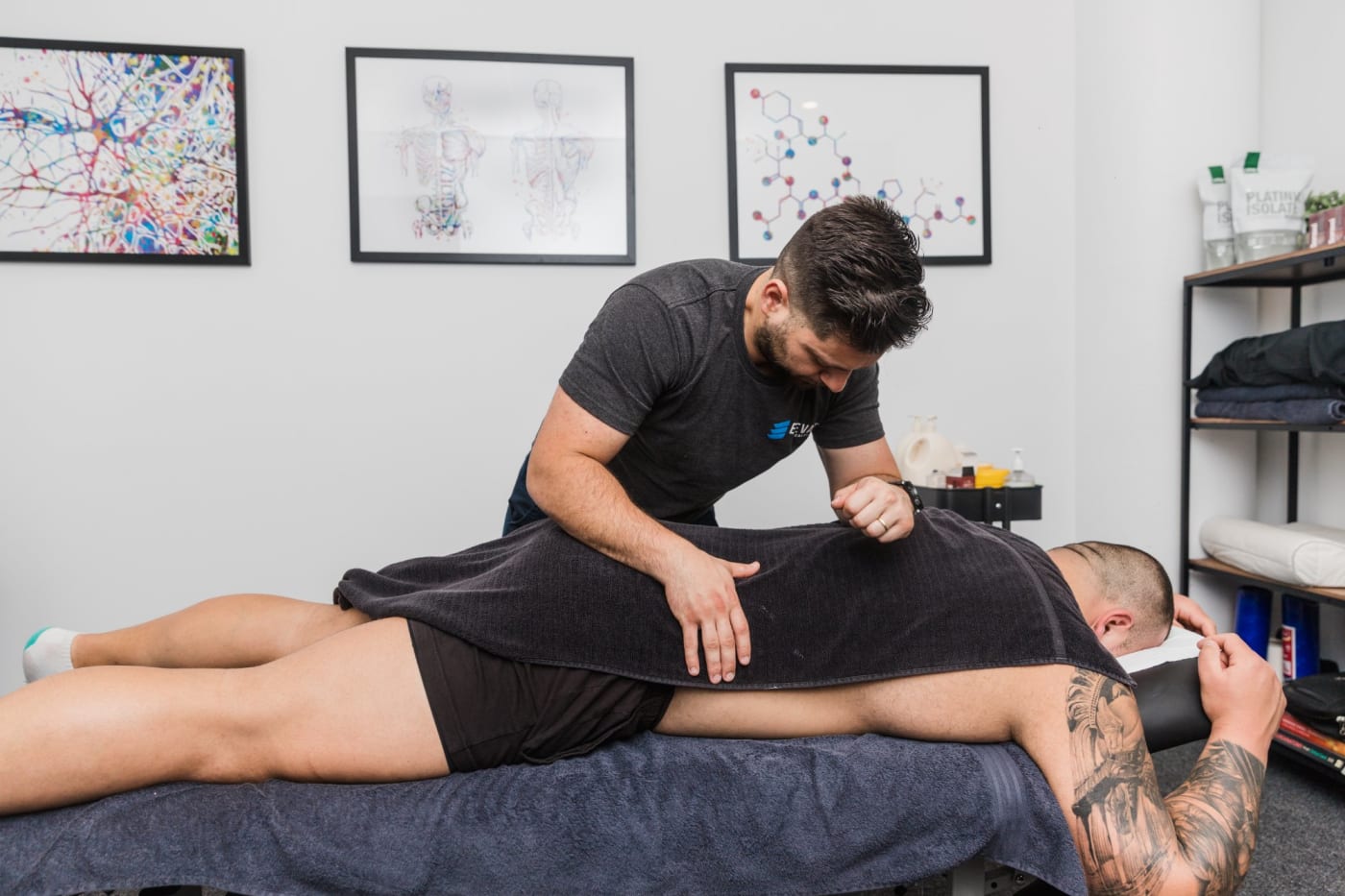
Our sports chiropractic and exercise physiology teams manage acute and subacute sprains and strains with an evidence-based approach combining manual therapy, progressive loading and return-to-sport criteria. Book an appointment at our Bella Vista or Earlwood clinic — no referral needed.
Our sports chiropractic team provides clinical assessment and management for sprains and strains across the Hills District and Earlwood. For a broader discussion of injury recurrence — particularly relevant for ankle and knee sprains — see our article on why your injury keeps coming back. Our exercise physiology team designs progressive return-to-sport programmes for Grade 2 and Grade 3 presentations.
Frequently Asked Questions
How do I know if I have a sprain or strain?
Location is the key guide: sprains involve ligaments (joint injury — ankle, knee, wrist) and strains involve muscle-tendon units (muscle injury — hamstring, calf, quadriceps). A clinical assessment — including palpation, stress tests and functional testing — provides a more accurate diagnosis than symptom description alone. Imaging is usually not required for most acute sprains and strains.
How long does a sprain or strain take to heal?
Grade 1 sprains and strains typically resolve in 1–2 weeks. Grade 2 injuries take 3–6 weeks. Grade 3 (complete rupture) may take 3 months or more, and surgical assessment may be required depending on the structure involved. Return to full activity should be based on functional criteria, not just pain resolution.
Should I use ice or heat for a sprain or strain?
For acute injuries (first 48–72 hours), compression and elevation are the most evidence-supported interventions for controlling swelling. The traditional RICE protocol is being updated — POLICE (Protection, Optimal Loading, Ice, Compression, Elevation) is more current guidance, emphasising early controlled loading rather than complete rest. Ice provides analgesic benefit; heat is more appropriate once acute inflammation has settled.
References
- Bleakley CM, et al. (2012). PRICE needs updating, should we call the POLICE? British Journal of Sports Medicine, 46(4), 220–221.
- Bahr R & Krosshaug T. (2005). Understanding injury mechanisms: a key component of preventing injuries in sport. British Journal of Sports Medicine, 39(6), 324–329.
- Verhagen EA, et al. (2004). The effect of a proprioceptive balance board training program for the prevention of ankle sprains. American Journal of Sports Medicine, 32(6), 1385–1393.
Ready to Get Started?
Book an appointment with our experienced team — same-day availability, NDIS, WorkCover & private health welcome.
Book an Appointment