
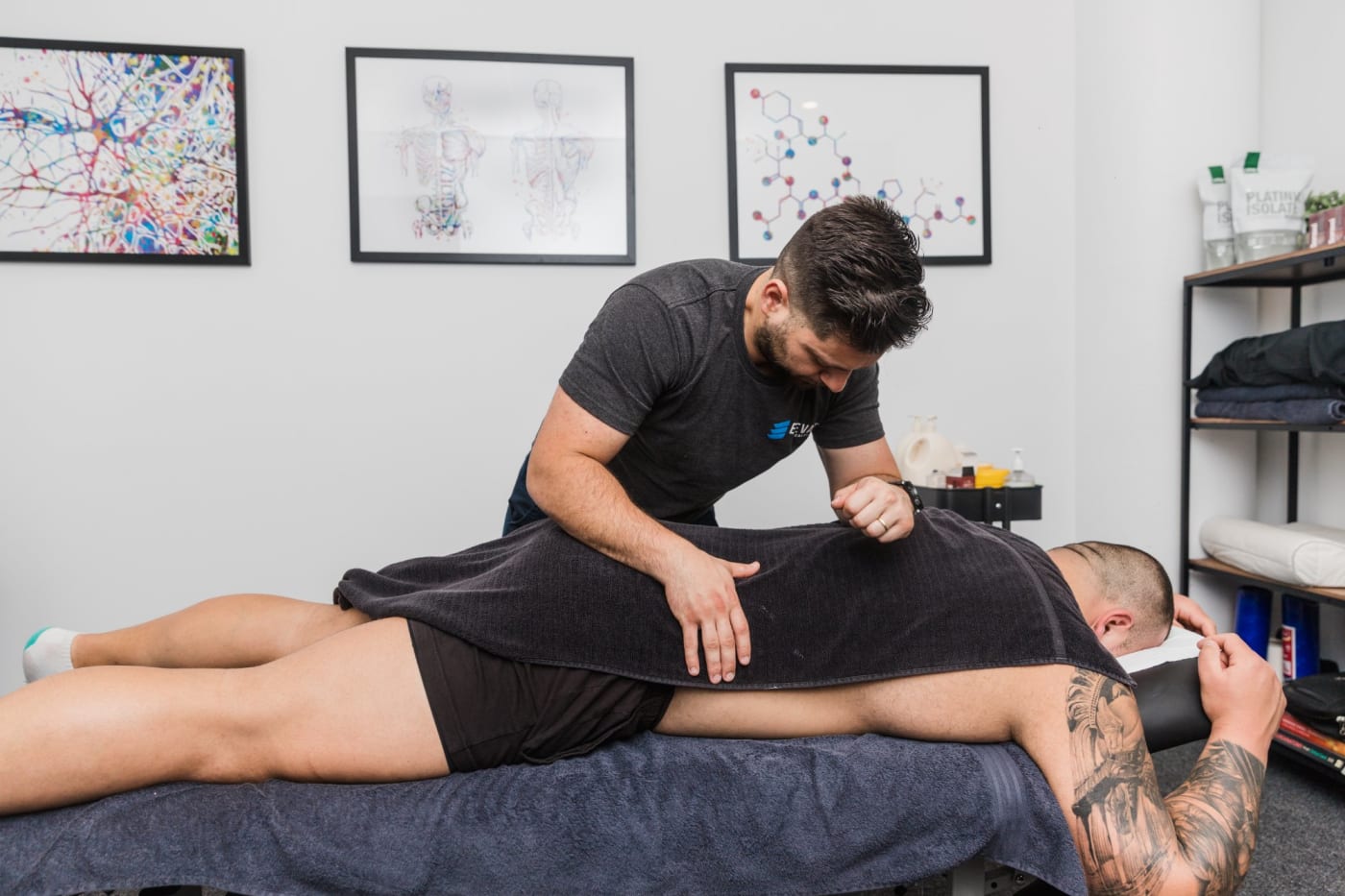
You're lying face-down on the treatment table. Your chiropractor positions your spine, places their hands, and applies a quick, controlled thrust. Then — pop. A sound you weren't expecting, but somehow your back instantly feels different.
If you've ever wondered what just happened, you're not alone. The chiropractic adjustment is one of the most misunderstood treatments in healthcare. Here's exactly what's going on — without the jargon.
Quick answer — what is a chiropractic adjustment?
- A precise, controlled force applied to a restricted spinal joint
- Restores normal joint movement and reduces nerve irritation
- The "crack" is harmless — a gas bubble in the joint fluid, not bones grinding
- Triggers a neurological response that reduces muscle tension and pain
- Performed only by AHPRA-registered chiropractors
What Is a Chiropractic Adjustment?
A chiropractic adjustment — also called spinal manipulation — is a highly specific, controlled force applied to a spinal joint that has become restricted in its movement. The goal is simple: restore normal joint mechanics so the surrounding structures (muscles, nerves, discs) can function properly.
Your chiropractor identifies the specific segment that's restricted through postural assessment, range of motion testing and palpation — then applies a precise, high-velocity, low-amplitude (HVLA) thrust to that specific joint. The whole technique takes about half a second.
What Is the "Crack" Sound?
This is the question everyone asks. The sound is called cavitation — the same thing that happens when you crack your knuckles.
Inside every joint is synovial fluid — a lubricating liquid that contains dissolved gases (primarily carbon dioxide, nitrogen and oxygen). When the joint is quickly stretched during an adjustment, the pressure inside drops suddenly. This causes the dissolved gases to rapidly form a bubble — and the pop you hear is that bubble forming or collapsing.
It is completely harmless. Nothing is breaking, cracking or grinding. And importantly — the crack is not the treatment. It's simply a byproduct of the joint being moved through its range. Many highly effective adjustments produce no sound at all.
What Happens in Your Body During an Adjustment?
The mechanical effect is just the beginning. Here's the full picture:
Joint Mobility Is Restored
The primary mechanical effect: a restricted joint is freed and moved through its normal range of motion. Patients often notice immediate improvement in their ability to rotate, flex or extend.
Muscle Tension Reduces
Restricted joints trigger protective muscle guarding in the surrounding tissue. The adjustment stimulates mechanoreceptors (sensory receptors) in the joint capsule, sending inhibitory signals to the spinal cord that reduce this muscle hypertonicity. That's why patients feel "looser" immediately after treatment.
Pain Signals Are Interrupted
The neurological stimulation of a spinal adjustment triggers the release of endorphins and activates spinal pain-gating mechanisms (as described by the Gate Control Theory of pain). This explains why pain relief can be immediate — before any structural healing has occurred.
Proprioception Is Reset
Joints contain proprioceptors — sensors that tell your brain where your body is in space. Restricted joints provide faulty proprioceptive input. Adjustments reset this signalling, which improves movement coordination and reduces the risk of re-injury.
What Conditions Respond to Adjustments?
The strongest evidence supports chiropractic adjustment for:
- Acute and chronic lower back pain — consistent strong evidence across multiple systematic reviews
- Neck pain — including acute mechanical neck pain and whiplash
- Cervicogenic headaches — headaches originating from the neck
- Sacroiliac joint dysfunction — a common source of buttock and lower back pain
- Thoracic (mid-back) pain — stiffness and pain between the shoulder blades
- Joint restrictions in the shoulder, hip, knee and ankle
Adjustment Techniques Used at Elevate Health
There's no single adjustment technique. We select the approach based on your age, condition, preferences and how your body responds:
Diversified Technique
The most common form — a precise HVLA thrust that typically produces cavitation. Highly specific and effective for most spinal conditions.
Activator Method
A small spring-loaded instrument delivers a gentle, controlled impulse. Ideal for patients who prefer a low-force approach, including children, older adults and those with osteoporosis.
Drop-Piece (Thompson) Technique
A section of the treatment table drops slightly as the adjustment is delivered, reducing the force required. Useful for patients who find standard manipulation uncomfortable.
Flexion-Distraction
A gentle, rhythmic pumping motion primarily used for disc injuries and lumbar stenosis. No thrust involved — just a slow, controlled decompressive movement.
Is a Chiropractic Adjustment Safe?
Chiropractic adjustment performed by an AHPRA-registered chiropractor is considered safe for the vast majority of patients. Before any adjustment, your chiropractor will complete a thorough assessment and health history to identify any contraindications.
The most common side effects are mild muscle soreness or fatigue for 24–48 hours after treatment — comparable to what you'd feel after a workout. Serious adverse events are extremely rare.
What to Expect After a Chiropractic Adjustment
Most patients notice an immediate change in movement or pain levels following an adjustment — a reduction in stiffness, an increase in range of motion or a decrease in local tenderness. This is the result of the neurophysiological effects of the manipulation: reduced muscle guarding, decreased sensitisation of the local mechanoreceptors and improved joint mobility.
Some patients experience mild post-treatment soreness — typically a dull ache in the treated area lasting 12–48 hours. This is a normal and expected response, similar to delayed onset muscle soreness after exercise. It reflects the mechanical change the joint has undergone, not damage or injury. Your chiropractor will advise you to apply ice, stay mobile and avoid prolonged static postures in the day or two following treatment.
A small number of patients feel no immediate change after their first adjustment — particularly those with chronic or long-standing presentations where the nervous system has had time to adapt to the altered joint mechanics. In these cases, the effects typically accumulate over the first 3–4 sessions as the joint mobility is progressively restored and the surrounding musculature adapts.
Chiropractic Adjustment at Elevate Health Clinic
At Elevate Health, chiropractic adjustment is always preceded by a thorough assessment — covering your history, movement, strength and neurological function. Adjustment technique is selected based on your specific presentation, your pain levels and your personal preference. Patients who are uncomfortable with high-velocity techniques can be managed equally effectively with low-force mobilisation and soft tissue approaches.
The adjustment itself is one component of your overall treatment plan — not the entirety of it. Your practitioner will also address contributing factors through exercise prescription, load management advice and soft tissue techniques. The goal is never just symptom relief in the room: it is improving your capacity to manage load independently between sessions and over the long term.
Frequently Asked Questions
How many adjustments will I need?
This depends entirely on your condition, how long it's been present and your health goals. Acute conditions often respond within 4–8 sessions. Chronic conditions typically require a longer course of care. Your chiropractor will set clear goals and reassess your progress regularly.
Does a chiropractic adjustment hurt?
The adjustment itself is typically quick and not painful. Some patients feel mild discomfort with the positioning before the thrust, particularly if the area is acutely inflamed. The technique is always modified to stay within your comfort tolerance.
Can I get adjusted if I have osteoporosis?
Yes — but the technique must be modified. High-velocity thrusts are contraindicated in advanced osteoporosis. We use instrument-assisted (Activator) or low-force mobilisation techniques that are safe and effective for patients with reduced bone density.
Why does my back feel so much better immediately after an adjustment?
The immediate pain relief is primarily neurological — the adjustment triggers endorphin release and activates pain-gating mechanisms in the spinal cord. The mechanical restoration of joint mobility compounds this effect over the following 24–48 hours.
Need help with this? Our team at Elevate Health Clinic in Bella Vista and Earlwood can assess and treat this condition. Book online or call us today.
To understand the broader context of chiropractic care, our article on what chiropractic care involves provides a useful overview for new patients. If you are wondering whether hands-on treatment alone is sufficient for long-term outcomes, see our guide on whether manual therapy fixes pain long-term. You can book an appointment at our Bella Vista or Earlwood clinic without a referral.
References
- Bialosky JE, et al. (2009). The mechanisms of manual therapy in the treatment of musculoskeletal pain: a comprehensive model. Manual Therapy, 14(5), 531–538.
- Cramer G, et al. (2002). The effects of side-posture positioning and spinal adjusting on the lumbar Z joints. Spine, 27(22), 2459–2466.
- Reggars JW. (2011). Chiropractic at the crossroads or are we just going around in circles? Chiropractic & Manual Therapies, 19(1), 11.
- Millan M, et al. (2012). Manipulation induces an immediate pressure pain threshold increase in latent myofascial trigger points. Journal of Physiotherapy, 58(1), 29–34.
Ready to Get Started?
Book an appointment with our experienced team — same-day availability, NDIS, WorkCover & private health welcome.
Book an Appointment