
You wake up stiff. You struggle to put your shoes on. By mid-afternoon, sitting is unbearable — but standing hurts too. If that sounds familiar, you're one of the 4 million Australians dealing with lower back pain right now.
The good news? Most lower back pain responds quickly to the right approach. The bad news? Most people are doing the wrong things — resting too much, chasing the wrong diagnosis on scans, or skipping the treatment that actually works.
This guide cuts through the noise. As a chiropractor and physiotherapist who has treated thousands of back pain patients in Bella Vista and Earlwood, here's what you actually need to know.
Quick answer — how to fix lower back pain fast:
- Keep moving — avoid bed rest
- Apply heat to reduce muscle spasm
- Start targeted mobility and strengthening exercises
- See a physio or chiropractor for hands-on treatment
- Address the root cause, not just the symptom
What Actually Causes Lower Back Pain?
Most people assume back pain means something is structurally broken. In reality, 90% of lower back pain is classified as non-specific — no single structural finding explains it.
Muscle and Ligament Strain
The most common cause. Overloaded or fatigued muscles from prolonged sitting, poor lifting or sudden awkward movements. Usually resolves in days to weeks with the right approach.
Facet Joint Dysfunction
The small joints between each vertebra become irritated or restricted. This causes a deep, aching pain — often worse in the morning, better once you get moving. Responds very well to chiropractic adjustment.
Disc Injury (Bulge or Herniation)
The intervertebral discs act as shock absorbers. Under repeated stress they can bulge or herniate — sometimes pressing on nerves and causing leg pain (sciatica). Important: disc bulges are extremely common and often completely painless. Research shows 40% of people over 40 have disc bulges on MRI with zero symptoms.
Sacroiliac Joint Dysfunction
The joint connecting your spine to your pelvis. When irritated, it causes deep buttock pain that often mimics sciatica — but comes from a completely different source.
The Biggest Mistake People Make
Getting a scan and chasing the finding. Imaging has its place — but structural findings frequently don't explain your pain. Research consistently shows that findings on MRI don't reliably predict pain or recovery. We regularly see patients with "normal" scans in severe pain, and patients with significant disc degeneration who are completely pain-free.
Treatment should be guided by your clinical presentation — not your scan result.
What Actually Works for Lower Back Pain
Stay Active
Bed rest was standard advice for decades. We now know it makes things worse. Movement promotes disc nutrition, reduces muscle deconditioning and helps your nervous system recalibrate its pain response. Gentle, consistent movement is non-negotiable.
Manual Therapy
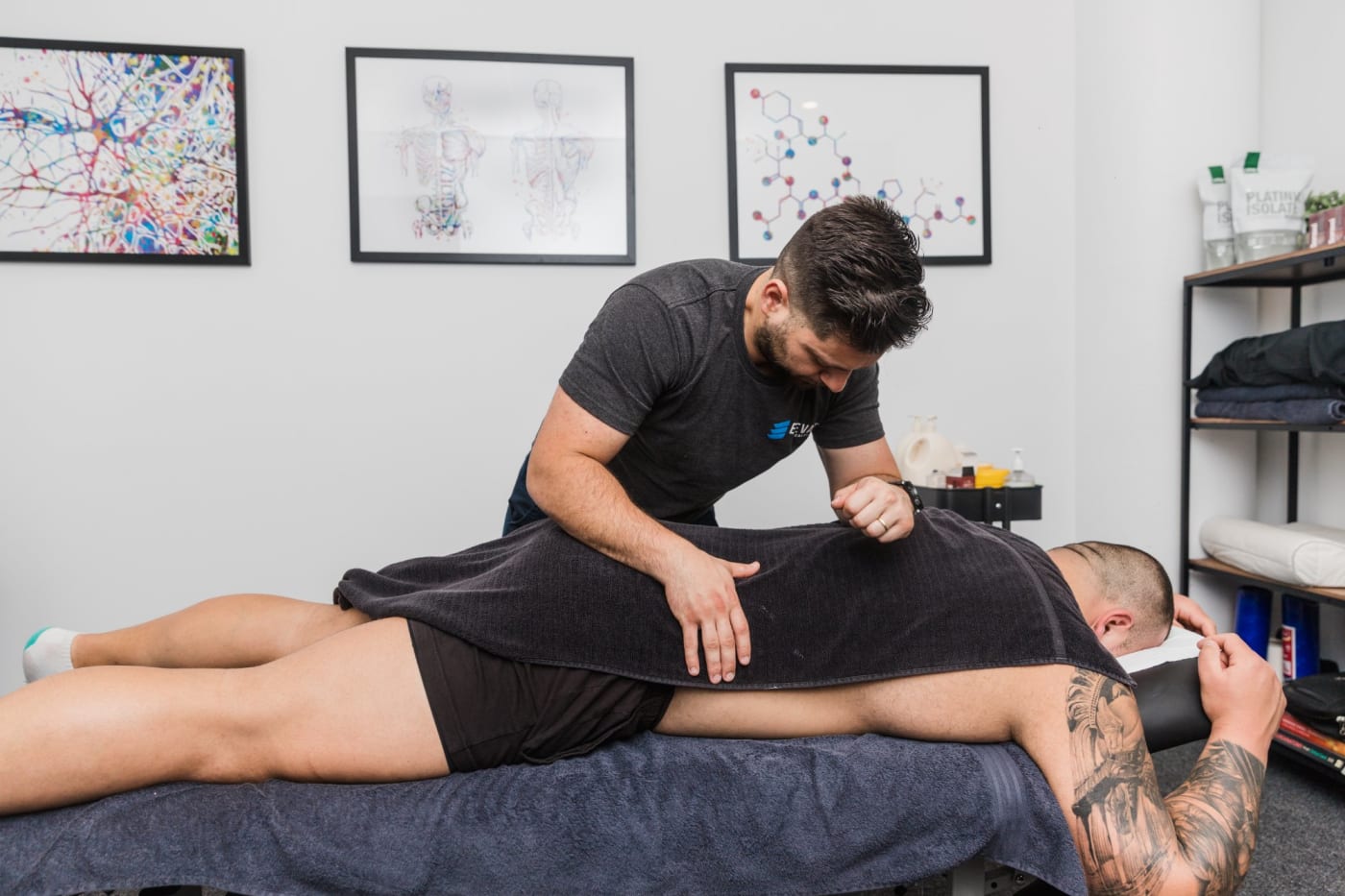
Hands-on treatment — spinal manipulation, joint mobilisation, soft tissue therapy — has strong evidence for both acute and chronic lower back pain. It reduces pain, restores movement and gets you back to function faster than passive rest alone.
Targeted Exercise
Generic gym exercises won't cut it. You need a program targeting the specific muscles failing you — typically the deep stabilisers (transversus abdominis, multifidus) and the posterior chain (glutes, hamstrings). Progressive loading of these structures is the most durable long-term solution.
Pain Education
Understanding that pain does not equal damage is genuinely therapeutic. Fear-avoidance behaviour — avoiding movement because you're scared of making things worse — is one of the primary drivers of chronic back pain. When patients understand their pain, they recover faster.
Exercises That Actually Work
Avoid crunches and sit-ups — they generate excessive disc compression. These are better:
Bird-Dog
From four-point kneeling, extend one arm and the opposite leg while keeping the spine neutral. Hold 3–5 seconds, 8–10 reps each side. Activates the multifidus and erector spinae with near-zero spinal compression.
Glute Bridge
Lying on your back, feet flat on the floor, push your hips to the ceiling by squeezing your glutes. Hold 2–3 seconds at the top. Glute weakness is one of the most overlooked contributors to back pain.
Dead Bug
Lying on your back, arms vertical, knees at 90 degrees. Slowly lower one arm and the opposite leg toward the floor while keeping your lower back flat. Return and repeat. Challenges the deep stabilisers without loading the spine.
McGill Side Bridge
Side-lying with elbow under shoulder, lift your hips to create a straight line. Hold 10–30 seconds. Targets the quadratus lumborum and obliques — key lateral stabilisers of the lumbar spine.
When Should You See a Professional?
See a chiropractor or physiotherapist if:
- Pain has lasted more than 2 weeks without improvement
- Pain is radiating into your leg
- You have numbness, tingling or weakness in a leg
- Pain significantly limits your daily function
- You've had multiple recurrences
Seek urgent medical attention if you experience loss of bladder or bowel control, numbness in the saddle area (inner thighs), or progressive leg weakness. These are red flags for cauda equina syndrome — a rare but serious emergency requiring immediate hospital care.
When to Seek Professional Help for Lower Back Pain
Most episodes of acute lower back pain improve significantly within 4–6 weeks without specific intervention — provided you stay active, avoid prolonged bed rest and manage load sensibly. However, professional assessment is warranted in several situations: if your pain is severe and worsening rather than gradually improving; if it is associated with leg pain, numbness or weakness; if it follows significant trauma; or if it is disrupting sleep or daily function to a degree that is unsustainable.
Earlier assessment generally leads to better outcomes. Patients who seek care within the first 1–2 weeks of an acute episode tend to recover faster and have lower rates of chronicity than those who wait several months before seeking help. This is particularly true for disc-related presentations, where early load management and movement guidance can significantly influence the trajectory of recovery.
At our Bella Vista clinic, same-day appointments are available for acute lower back pain. Our exercise physiology team provides progressive rehabilitation for patients transitioning from the acute phase into longer-term strengthening. No referral is required.
Frequently Asked Questions
How long does lower back pain take to heal?
Acute lower back pain typically improves within 2–6 weeks with appropriate management. Chronic lower back pain (lasting more than 12 weeks) takes longer — often 3–6 months — but responds well to a combined manual therapy and exercise approach.
Should I use ice or heat for lower back pain?
For acute injury in the first 48–72 hours, ice can reduce localised inflammation. After that, heat is generally more effective — it reduces muscle spasm, increases tissue extensibility and improves blood flow to the area.
Is walking good for lower back pain?
Yes — walking is one of the most evidence-supported interventions for lower back pain. It activates deep stabilisers, promotes disc hydration through cyclic loading, and helps reduce fear-avoidance behaviour. Aim for 20–30 minutes at a comfortable pace daily.
Can a chiropractor fix lower back pain?
Chiropractic adjustment has strong evidence for both acute and chronic lower back pain. At Elevate Health, we combine spinal manipulation with soft tissue therapy and exercise prescription — addressing the joint mechanics, the muscular system and the movement patterns driving your pain.
Will I need surgery?
The vast majority of lower back pain — including disc herniations and nerve compression — resolves with conservative (non-surgical) treatment. Surgery is considered only when conservative care has failed after 6–12 weeks, or in rare cases of progressive neurological deficit.
Need help with this? Our team at Elevate Health Clinic in Bella Vista and Earlwood can assess and treat this condition. Book online or call us today.
Our Bella Vista chiropractors and exercise physiologists provide integrated management for lower back pain — combining hands-on treatment with progressive rehabilitation through the Dynamic Resilience System™. For more on why back pain so often recurs, see our article on why your back pain keeps coming back, and for guidance on imaging, see do you actually need a scan for back pain.
References
- Hartvigsen J, et al. (2018). What low back pain is and why we need to pay attention. The Lancet, 391(10137), 2356–2367.
- Rubinstein SM, et al. (2019). Spinal manipulative therapy for acute low back pain. Spine, 44(15), e882–e900.
- Hayden JA, et al. (2005). Exercise therapy for treatment of non-specific low back pain. Cochrane Database of Systematic Reviews, (3).
- Pengel LHM, et al. (2003). Acute low back pain: systematic review of its prognosis. BMJ, 327(7410), 323.
Ready to Get Started?
Book an appointment with our experienced team — same-day availability, NDIS, WorkCover & private health welcome.
Book an Appointment